




Individual courses
Based on the firm belief that academic excellence should not be limited to those studying for a degree, the university takes pride in offering further education programmes (leading to Certificates of Advanced Study) and Individual Courses to anyone wishing to be immersed in the intellectual heritage of the Dominicans.
Certificates of Advanced Study and individual courses are validated in the same way as Bachelor level courses. A paper of 12000-16000 characters, including spaces is required for each course. The study duration for a certificate is 12 months, according to the pace and rhythm of each student, under supervision by a tutor.
Choose between:
- 15 Certificates of Advanced Study, in Theological or Philosophical Studies
- Over 500 Individual Courses
Choose your course by using the search engine and click on the title to see the detailed outline.
- Accompanied courses – you have access to the learning platform and your studies will be supervised by an academic tutor. These courses are worth 3 ECTS credits which can be counted towards a study programme with Domuni or at another academic institution.
- Read only courses: you will receive the PDF of your chosen course within 48 hours
Courses search
E-seminar: The Gospel Across Cultures: Greek, Latin, and Syriac Patristic Perspectives (SEM 124)

E-seminar in Theology
Srecko Koralija
From 14 April to 8 June 2025
E-Seminar: The miracle narratives in both the Old and New Testaments

E-Seminar in Theology
From October 6 to November 30, 2025
E-Seminar: The Role and Relevance of Religion in the Contemporary World

E-seminar in Religion
by Isaac Mutelo
From 15 April to 10 June 2024
E-Seminar: Upholding Human Rights and Justice Today: Religion, Media, and NGOs

SEM48 - Human Rights, Philosophy and Religious Studies
4th October - 29th November 2021
presented by Isaac Mutelo
Early Christian Art
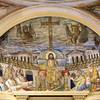
This course critically reviews early Christian and Byzantine art from the 2nd to 6th Century.
Early Christian-Muslim Relations (ENREL07)
A study of the history of Arab Christianity, the Advent of Islam in the East, the cultural contributions of Arabic-speaking Christians, early Christian-Muslim theological conversations, and the beginnings of Christian theology in the world of Islam.
Eastern Church history and cultural landmarks

This course will look at some issues of theological controversy between East and West.
Ecclesiology

This course explores the mystery of the Church as seen in the light of Vatican II.
Ecumenical Biblical Hermeneutics

The aim of this first set of readings is to gain familiarity and/or to review the literary history of the Bible: namely, religious, socio-political, cultural factors which shaped the structure and content of both testaments.
Ecumenical Hagiology

In the lives of the sains lifes " lives" the Christian vision of God, man, and the world which stand all out very clearly. Men can learn almost as much about the real meaning of Christianity from the legends of the saints produced within the tradition of the Church as from the authentic lives themselves. Through the reading and studying the lifes of the saints who arrived before us in the promised land, we came to know how God works in the daily lives of Christians and how faith can be lived not only in good times but especially during persecution and suffering. This helps us to appreciate more our faith and make us grow in loving our brothers as part of God's providence.
Ecumenical Theology

As reasoned discourse about God ecumenical theology is focussing on God’s will for unity among Christians.
English for Economics (SHS-ETC09)

This course aims at expanding students’ vocabulary and improving their understanding of the body of knowledge in Economics.
English, language and culture (EDOMU1111 (SHS-LANG01))

This course is aimed at students who have a level B1 (CEFR) or higher in English.
Environmental Protection in Armed Conflicts [2622]
Environmental degradation is one of the major consequences of armed conflict worldwide. The first part of the course, “The Environment as a Method of Warfare?”, provides a syntactic and semantic analysis of the key concepts contained in the course title, namely protection, the environment and armed conflict.
Epistemology [2480]
The aim of this course is to provide students with a systematic and comprehensive introduction to some of the key themes in Epistemology (the theory of knowledge). The course gives a good introduction, then moves to the analysis of “knowledge” in general, with an introduction of historical elements in the development of Epistemology (begins with Gnoseology and the Epistemology).
Ethics of Artificial Intelligence and Robotics [2490]
This course provides a comprehensive introduction to the ethics of artificial intelligence (AI) and robotics by combining conceptual, analytical, and ethical perspectives.
Ethics: from Ancient to Modern [2277]
This course offers a structured and rigorous journey through the history of ethics, from Plato to contemporary utilitarianism, in order to highlight the diversity of possible foundations for morality.
Financial Management

To understand the basic notion on financial management specially on the key principles of finance, the important role that financial markets have on the economy.
Food Governance and Development Goals
The course introduce the students to the complex architecture of the global food governance, its historical evolution and the inherent challenges.
Foundations of Ethics [2527]
This course introduces the philosophical foundations of ethics through a close reading of the major works of Plato and Aristotle. It begins by defining ethics as a branch of philosophy concerned with the rational search for the good, before examining the origins of ethical thought in ancient Greece.