




News
Contemporary Art in Churches: Welcoming, Discerning, Engaging in Dialogue
2 october 2026
What happens when a resolutely contemporary artwork is placed in a church? It may inspire wonder, surprise, or bewilderment, and may sometimes provoke rejection. In The Church and Contemporary Artists: The Challenges of Contemporary Creation in Churches, Frédéric Curnier-Laroche explores the complex relationship between artistic creation, Christian tradition, and ecclesial responsibility. Through several successful and contentious experiences, he invites readers to move beyond questions of taste alone in order to rediscover the conditions for genuine dialogue between the Church and artists.
A contemporary artwork in a church is never quite an artwork like any other. It enters a space inhabited by history, a community, liturgy, and faith. Yet it also remains an artistic creation, with its own freedom, language, and sometimes disruptive power.
It is precisely this tension that Frédéric Curnier-Laroche’s book seeks to explore. How can creation be welcomed without asking the artist to reproduce the forms of the past? Conversely, how can one respect the particular purpose of a religious building without reducing every artistic intervention to mere decoration? Behind these aesthetic questions lie deeper issues: the relationship with tradition, the exercise of authority, the freedom of the creator, and the very possibility of conveying faith through new forms.
Assy: When Novelty Causes Scandal
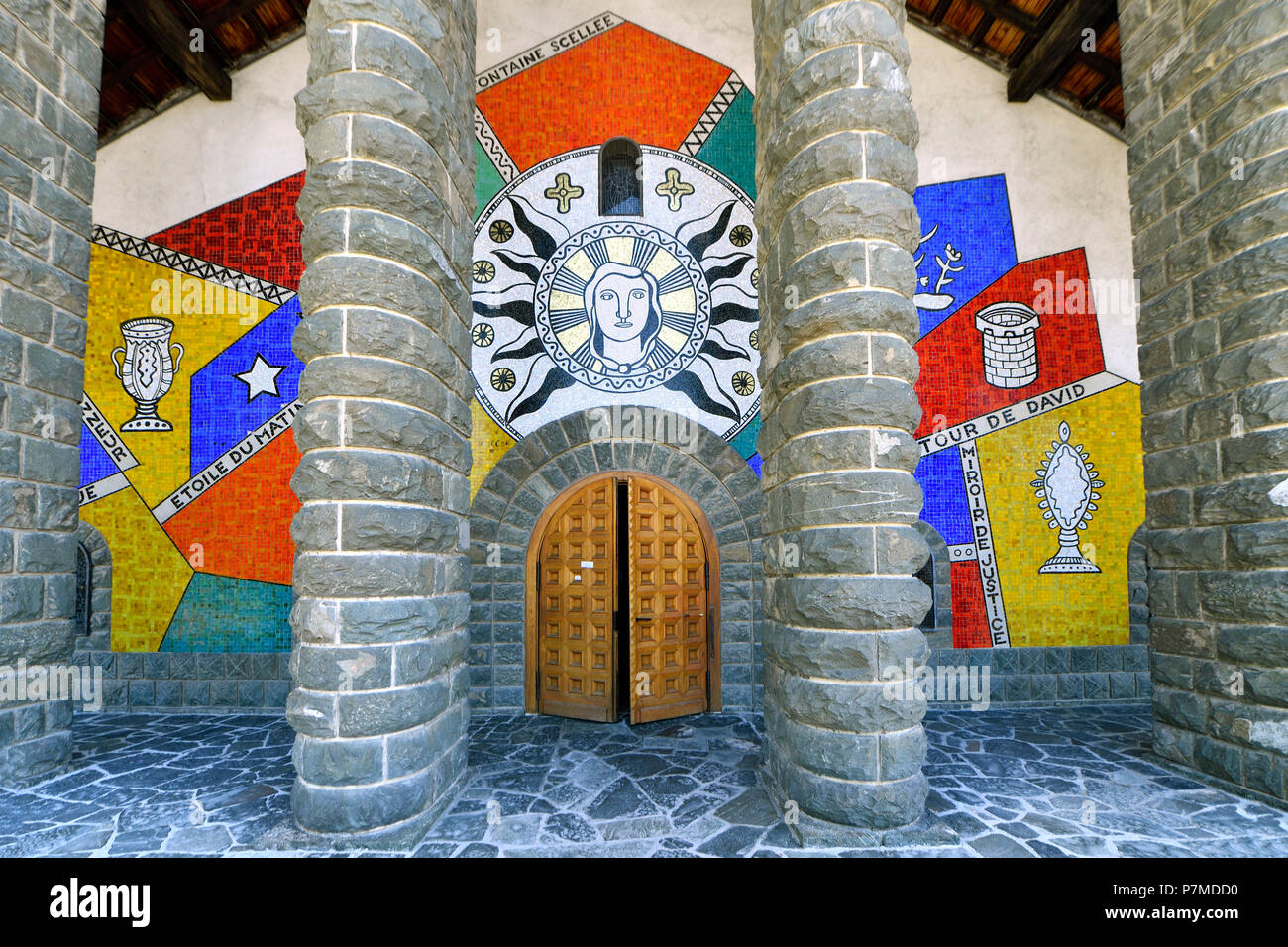
The Church of Notre-Dame-de-Toute-Grâce on the Plateau d’Assy constitutes an emblematic episode in the history of twentieth-century sacred art. Under the direction of architect Maurice Novarina and the Dominican friar Marie-Alain Couturier, several of the leading artists of their time were invited to contribute to the church. Fernand Léger created a vast mosaic dedicated to the Virgin for the façade. The author emphasizes an essential point: although Léger was distant from the Catholic faith, he was nevertheless capable of creating a work that resonated deeply with the site. The issue, therefore, is not primarily whether the artist belongs to the ecclesial world, but whether one can recognize what his or her particular talent is able to bring forth.

The reception of Germaine Richier’s Christ was far more violent. This emaciated and almost disfigured body radically breaks with conventional representations of the Crucified Christ. Removed from the choir in 1951 following an intense controversy, the work nevertheless compels viewers to look at the Passion differently: no longer through an idealized body, but through Christ’s proximity to all suffering humanity.

The conflict thus reveals a decisive question: must a Christian artwork first conform to an inherited representation, or can it open an unprecedented path toward the mystery it seeks to signify?
Grignan: Allowing Light to Transform the Space
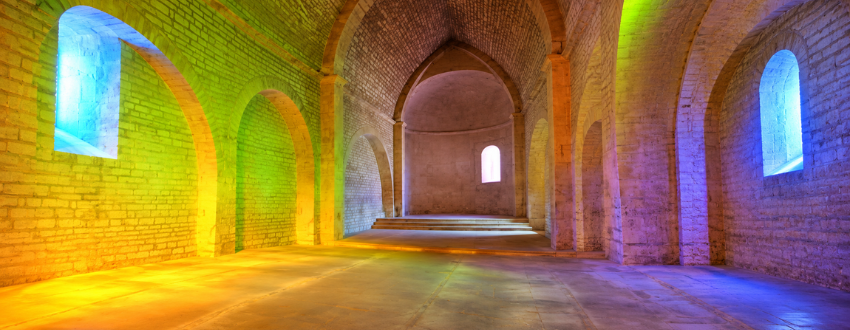
More than sixty years after Assy, Ann Veronica Janssens’s intervention in the Saint Vincent Chapel in Grignan offers an entirely different example. From the outset, the project was conceived as an ensemble: stained glass, light, furnishings, and architecture were to engage in dialogue. The artist chose blocks of colored glass whose tones vary according to the hours of the day: pink in the apse, blue to the north, green to the south, and yellow-orange for the rose window.
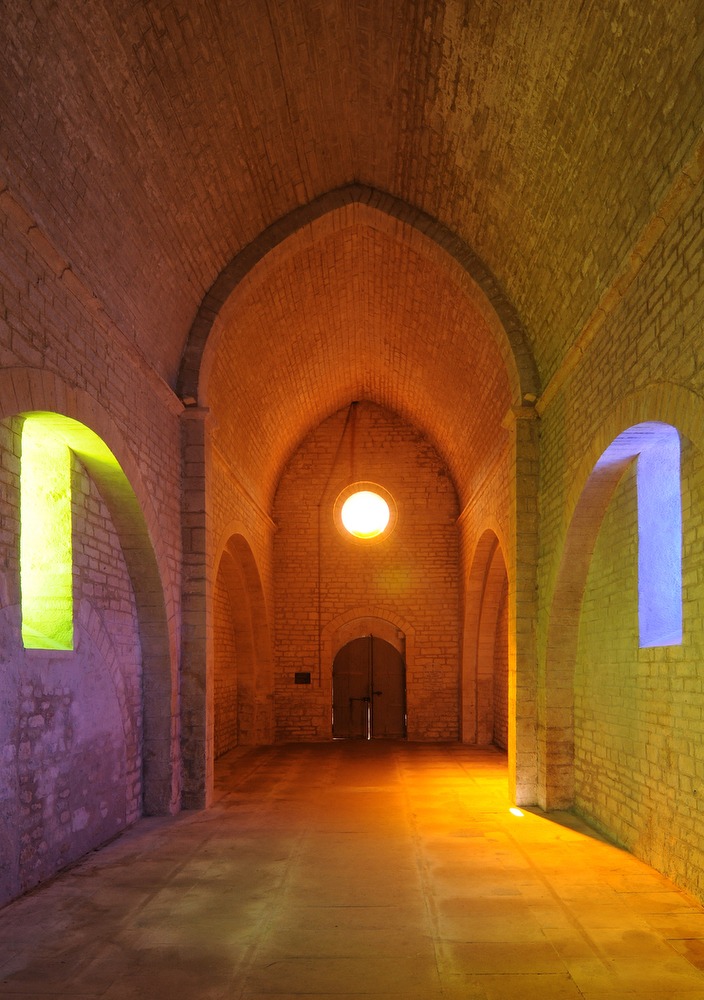
There is neither a biblical scene nor a saint’s figure here. Yet the space becomes deeply conducive to contemplation. Light colors the walls, shifts the shadows, and continually transforms the perception of the chapel. As the day unfolds, the visitor no longer merely looks at a work of art; rather, the visitor enters into an experience.
For Frédéric Curnier-Laroche, this work demonstrates precisely how a highly contemporary artistic expression can fulfill the spiritual vocation of a site without imitating earlier forms. The sensory experience can become a path toward contemplation.
At Boulogne-Billancourt, Trust as a Method
The Stations of the Cross created by Agathe Stefani and Aude Carré-Sourty for the Church of Sainte-Cécile in Boulogne-Billancourt highlights another dimension: the quality of the relationship between the commissioner and the artist.
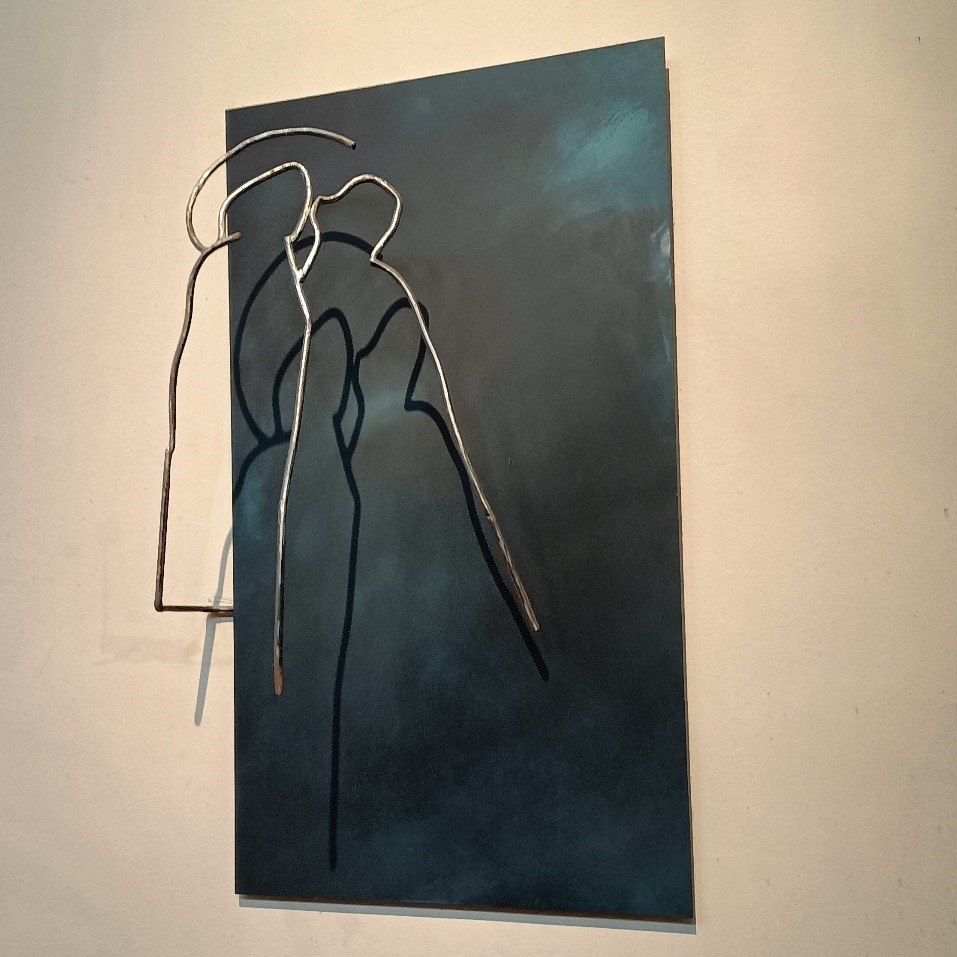
The project emerged from an encounter with a work that deeply moved the parish priest. When he subsequently commissioned the two artists to create a Stations of the Cross, he offered only one guiding principle: to begin with the Gospel texts. For the rest, he chose to place his trust in them. No preliminary sketches were required, and there was no constant supervision: the framework was established, and creation was then allowed to take place.
Painting, metal, shadow, emptiness, and light consequently became the elements of a shared language. Scripture nourished the creative process without imposing a predetermined form upon it. The example is particularly illuminating: genuine dialogue does not require the Church to relinquish all standards, nor does it ask the artist to work without any relationship to the site and its purpose. It presupposes that each party recognizes the competence and responsibility of the other.
From Control to Discernment
This is probably one of the book’s most stimulating themes. For a long time, the question of art in churches was approached primarily from the perspective of control: Is the work appropriate? Is it compliant? Is it sufficiently explicit in its religious character? Frédéric Curnier-Laroche proposes shifting the question. He identifies several criteria: first, recognizing the artist’s distinctive genius; considering the work’s capacity to open onto mystery rather than its conformity to established models; accepting the emergence of new forms; and, finally, rethinking the exercise of ecclesial authority itself.
The aim, therefore, is not to eliminate discernment, but rather to deepen it.
This shift nevertheless requires a culture of dialogue. The author therefore emphasizes the role of diocesan commissions for sacred art, as well as the formation of clergy and the faithful, respect for expertise, and, above all, genuine engagement with artists.
Contemporary creation ultimately confronts the Church with a question that extends far beyond the artistic domain: how can it remain faithful to what it has received without confusing fidelity with repetition? For their part, artists may discover in the church something other than an exhibition space: an inhabited place in which their work enters into relation with a community, a memory, and a spiritual expectation. Between the Church and artists, the essential task may therefore not be to reach agreement too quickly. It is first to make encounter possible. For when each accepts the need to listen to the other’s language, contemporary creation can do more than enter a church: it can still help open a space for mystery today.
Further information
Purchase the book in print and digital editions here.
Discover the courses taught by Professor Frédéric Curnier-Laroche, available in French:
- La théologie de l'image
- La Bible dans l'art I
- La Bible dans l'art II
- Une histoire de l'art en son contexte I : La préhistoire et les civilisations anciennes (Europe - Afrique)
- Une histoire de l'art en son contexte II : L’art de la Grèce ancienne
- Une histoire de l'art en son contexte III : L'art romain, luxe républicain et impérial