




News
Looking Back at the 9th Interdisciplinary Perspectives on Leadership Symposium
12 may 2026
From May 6 to 9, 2026, the 9th Interdisciplinary Perspectives on Leadership Symposium was held in Chania, Crete (Greece), bringing together international researchers and specialists around a particularly timely theme: “Leadership, Human Flourishing, and Well-Being.” This edition explored the transformations of contemporary leadership in a world shaped by uncertainty, technological change, and evolving expectations regarding quality of life at work.
Among the keynote speakers were Dr. Gretchen Spreitzer, Professor of Management and Organizations at the University of Michigan, internationally recognized for her work on positive leadership and human development in the workplace; Dr. Paul Frijters, Professor of Well-Being Economics at the London School of Economics and Political Science; and Dr. John Antonakis, Professor of Organizational Behavior at the University of Lausanne, specializing in leadership dynamics and decision-making processes.
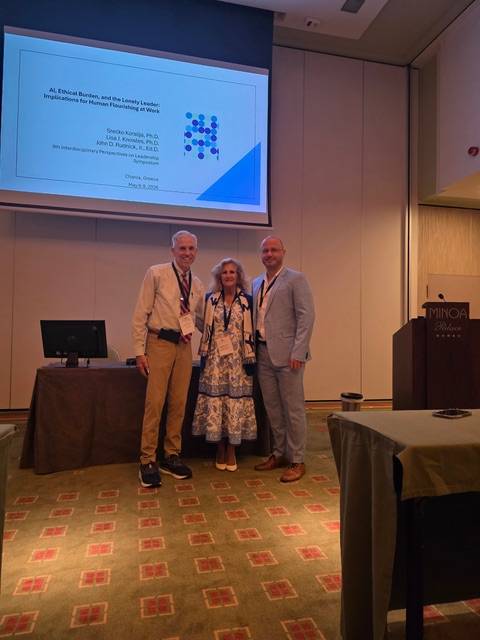
On this occasion, Dr. Srećko Koralija, O.P., Director of the Domuni Research Institute and Scientific Coordinator of the Laboratory of Intelligence and Pedagogical Research (LIRP), presented a paper entitled: “AI, Ethical Burden, and the Lonely Leader: Implications for Human Flourishing at Work.” The paper, resulting from ongoing research conducted with Dr. Lisa J. Knowles (Cyberminds Research Institute) and Dr. John D. Rudnick (Thomas More University), forms part of an interdisciplinary reflection at the intersection of leadership studies, ethics, organizational psychology, and artificial intelligence.
The research focuses on a question that remains insufficiently explored in academic literature: the loneliness of leadership in AI-augmented work environments. The authors argue that this loneliness constitutes a distinct and specific dimension of workplace well-being, particularly intensified in contexts where leaders are required to make complex decisions with the support—or under the pressure—of artificial intelligence systems.
The study notably draws upon the analytical frameworks of BANI (Brittle, Anxious, Nonlinear, Incomprehensible) and VUCA (Volatile, Uncertain, Complex, Ambiguous), now widely used to describe contemporary organizational environments. In such unstable and difficult-to-predict contexts, leaders face increasing responsibilities, contradictory expectations, and decision-making overload reinforced by digital technologies.
The researchers demonstrate that the integration of artificial intelligence into decision-making processes does not necessarily reduce the burden of leadership; on the contrary, it may intensify certain forms of isolation. AI offers unprecedented capacities for analysis, prediction, and automation, yet it also introduces new ethical and relational tensions. Leaders must constantly arbitrate between efficiency and human responsibility, innovation and trust, rapid decision-making and moral discernment.
The paper therefore examines how AI influences the selection of leadership styles before, during, and after crisis situations. The authors analyze the adjustments made by leaders confronted with environments in which algorithmic tools become indirect actors in decision-making processes. In these circumstances, the central question is no longer solely what decisions should be made, but also how to preserve a form of humanity in the exercise of power and responsibility.
The study adopts an approach combining theoretical synthesis and qualitative modeling, structured around three principal contributions.
The first contribution seeks to deepen the understanding of loneliness as a phenomenon. The authors distinguish several dimensions of this experience: emotional, physical, collective, and existential. They demonstrate that the loneliness of leadership cannot be reduced to simple social or hierarchical isolation. It also emerges from a sense of asymmetrical responsibility, in which leaders remain alone in facing the moral consequences of decisions that may be partially delegated to technological systems. This loneliness is amplified when leaders alone must assume responsibility for complex arbitrations within increasingly automated organizations.
The second contribution concerns the cultural, ethical, and contextual dimensions of AI adoption. The authors highlight several risks, including algorithmic bias, the erosion of trust between individuals and institutions, and digital divides that intensify organizational inequalities. The study emphasizes that technologies are never neutral; their integration depends on cultural contexts, normative frameworks, and social representations of leadership. In some organizations, AI may strengthen collaborative capacities and improve decision quality; in others, it may increase distrust, dehumanization, or the dilution of responsibility.
Finally, the third contribution of the paper concerns leadership models capable of supporting a balanced integration of artificial intelligence. The authors demonstrate that certain leadership styles—particularly those grounded in emotional intelligence, ethical responsibility, and relational capacity—make it possible to better reconcile technological innovation with human well-being. The study underscores the importance of leadership capable of interpreting data without abandoning human judgment, mobilizing technological tools while maintaining relationships of trust, and integrating demands for efficiency without sacrificing the human dimension of work.
Dr. Srećko Koralija’s presentation fully contributed to contemporary debates on the future of work and the transformations of leadership in the digital era. It helped illuminate the human, ethical, and existential challenges raised by artificial intelligence in organizations, while reaffirming that technological development cannot be dissociated from the question of human well-being and flourishing.