




News
Where Does Domuni Come From? In the Beginning, There Was a Dream
7 september 2026
How did an idea born in the early days of the Internet become an international university? And what shapes Domuni’s identity?
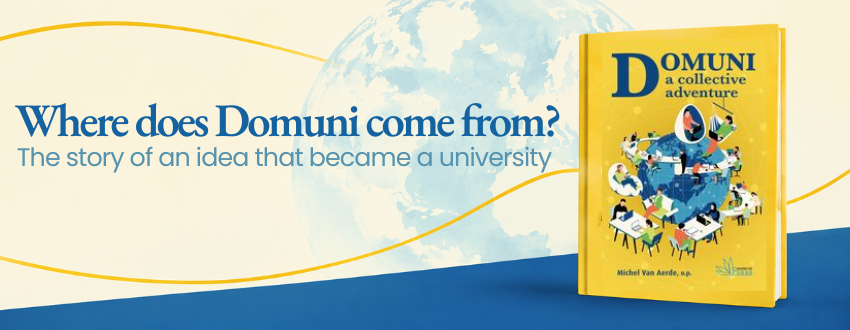
To explore these questions, this series returns to Domuni, une aventure collective, by Dr. Michel Van Aerde, O.P. Month after month, we will draw from it excerpts recounting the major stages of this history: its origins, its choices, its encounters, its challenges, and its development.
First episode: “Domuni: In the Beginning, There Was a Dream”
A journey back to Domuni’s very beginnings, born from the desire to make distance a space for encounter, dialogue, and transmission, faithful to the Dominican vocation.
In the beginning was the Word 39. Saint Dominic once spent the night conversing with his innkeeper, who was a Cathar from Toulouse. Meeting others was at the heart of the apostle’s life, regardless of their culture, beliefs or way of thinking. The process of dialogue is more important than its outcome. It is a way of life in itself that speaks volumes. As Brother Marcel Dubois, who took Israeli nationality after the 1948 war and taught philosophy at the Hebrew University of Jerusalem, pointed out, we have to start by clearly identifying our points of contention: what we agree to disagree on. The aim is not to convince each other, but to talk to each other. When a family planning officer who has witnessed unwanted pregnancies, a monk and African priests with sometimes “macho” attitudes, and others meet to discuss issues affecting half the world’s population, the points of view diverge profoundly. However, under the guidance of a wise teacher, these exchanges transform into a shared exploration based on mutual respect.
The Internet makes these intense encounters possible. For instance, a young Christian family man living in Mali who is threatened with death by jihadists can find a natural affinity with a Pakistani or an Iraqi when talking about interfaith dialogue. This dialogue, nourished by profoundly different experiences, can offer Europeans, who are dealing with tensions of their own, new perspectives.
Do not be fooled into thinking that distance hinders communication; experience shows that boundaries reassure and foster trust. It is the forbidden that enables expression. At a seminar on comparative religions organised by the Lumen Vitae International Centre, during which I discussed magic from a Voodoo perspective, the participants began to speak 40 openly. We discovered that a superior had used magic to get elected, how this had been uncovered and punished, and that politicians had also used magic for the same purpose. Such transparency would never have been achieved if the people we spoke to had been sitting in the same room together.
As Pierre Claverie used to say 41, the Order’s project is to be present on the fault lines. At the heart of the O.P. is a passion for engaging with others. This mission is rooted in the heart of the Trinity: one God in three persons. As the Father hath loved Me, so have I loved you. Continue ye in My love. The ministry of the Word is not just another service: we lend our bodies to it and are inextricably linked to it. The medium is not a mere instrument. It colours the message to the point that it becomes the message itself. If the way in which we deliver something is more important than the thing itself, the way in which we speak can be revealing, as can the way in which we remain silent in certain situations. Poverty, vulnerability and dependence are inherent to the Gospel when it is passed on. To depart from it is to betray it. Domuni is a theological project in itself; it is also a “theological place”. It bears witness to a certain “spirit”. To write its history is to give an account of a vocation: “The call is only heard in the response itself” 42.
To begin with, we had modestly envisaged creating a network bringing together the Dominican study centres with the Catholic institutes at its heart. Convinced that it would require a great deal of human resources – teachers and computer specialists – and therefore financial resources far beyond our capacities, we thought that no institute could achieve this alone. It was in this spirit that we brought together the deans of the French theology faculties to present our idea. But to our great surprise, they were far from grasping the potential of the new technologies, treating our proposal as if it were simply a question of creating yet another little distraction. Faced with this lack of vision, we mobilised our own resources to gradually build up a website and put together a series of courses.
Without taking ourselves too seriously, we presented these lessons not as “courses”, but as “hiking trails”, because theology, for our contemporaries, should be a pleasure, even a luxury. It had to be “fun”, as the Americans say: playful and open to all. Structured by professionals like Brother H. Ponsot and our first IT specialist, our institution has grown thanks to the commitment of passionate volunteers.
We started out as a group of institutions and we had to go it alone. We brought together volunteer teachers on an autonomous teaching platform, ready to develop its own network around it. In fact, we were not starting from scratch. The function creates the body. It was the need for resources that revealed the wealth of teaching material in our libraries, drawers and hard drives, and we had to make the most of it. New teachers were coming forward.
If faith is not communicated, it dies, because it is in the nature of faith to spread. The Second Vatican Council says that the nature of the Church is to be missionary, which means that a Church that is not missionary is distorted. In the absence of resources, we have followed Thomas Aquinas’ maxim: All thou canst 43, do thou endeavour. We dared, we took risks and we persevered. One of Jesus’ statements surprised me. He told his disciples that they would do greater works than he had done 44. How was that possible? Herein is My Father glorified, that ye bear much fruit 45. The Internet allowed us to multiply our efforts and, since the harvest was bountiful and the labourers few, we introduced the combine harvester!
39 Gospel of John, chapter 1, verse 1
40 To write, I am sorry, but this slip of the tongue bears such significance!
41 Dominican, Bishop of Oran, assassinated on 1 August 1996.
42 Levinas, Autrement qu’être ou au-delà de l’essence (Otherwise Than Being or Beyond
Essence), The Hague: M. Nijhoff, 1974, p. 190 – quoted in J.-L. Chrétien, L’Appel et la
réponse, p. 41.
43 Quantum potes, tantum aude (in the hymn Lauda Sion, verse 2).
44 Jn 14:12: Verily, verily I say unto you, he that believeth in Me, the works that I do he
shall do also; and greater works than these shall he do, because I go unto My Father.
And whatsoever ye shall ask in My name, that will I do, that the Father may be glorified
in the Son. If ye shall ask anything in My name, I will do it. If ye love Me, keep My
commandments. Jesus insists: this is not optional.
45 Jn 15:8.
Find the complete book, available in print or digital format, here.