




News
Vitoria: A Light for the University Today
11 june 2026
On the occasion of the fifth centenary of Francisco de Vitoria’s appointment to the Chair of Prima at the University of Salamanca, the Francisco de Vitoria University inaugurated the Seventh Razón Abierta Congress on its Madrid campus. Held from 8 to 10 June, this international congress, under the theme “Francisco de Vitoria: A Light for an Uncertain World,” brings together scholars and experts from numerous countries to examine the contemporary relevance of the Dominican master of Salamanca.
The choice of such a theme is not merely commemorative. It invites participants to revisit Vitoria not as a static historical figure, but as an intellectual resource for addressing contemporary challenges: international law, just war, economics, human rights, artificial intelligence, migration, and the very mission of the university. Five hundred years after he began his distinguished teaching career at Salamanca, his thought continues to illuminate those places where the foundations of law, justice, and the common good are being sought.
Under the Sign of Open Reason
The institutional opening of the congress was led by Daniel Sada, Rector of Francisco de Vitoria University, and Leopoldo Prieto, Director of the Congress and Professor of Modern Philosophy at UFV. Both emphasized the profoundly academic vocation of the gathering: to foster dialogue among disciplines, to question established certainties, and to seek, within Vitoria’s legacy, a way of intellectually inhabiting the uncertainties of the present.
The concept of “open reason,” which lies at the heart of the identity of Francisco de Vitoria University, provides the congress with its guiding orientation. It refers to a form of reason that is not confined to calculation, efficiency, or technical specialization, but is willing to engage with the entirety of reality. From this perspective, Vitoria’s insights concerning human dignity, natural law, the rights of peoples, circulation, and the community of the world acquire renewed significance.
The congress has brought together more than 230 registered participants from 15 countries and includes 66 papers accepted following evaluation by the scientific committee. The discussions address, among other themes, the School of Salamanca, war, civil authority, economics, natural law, human rights, artificial intelligence, and the future of the university.
Marie Monnet, Rector of Domuni Universitas, Invited to Open the Congress
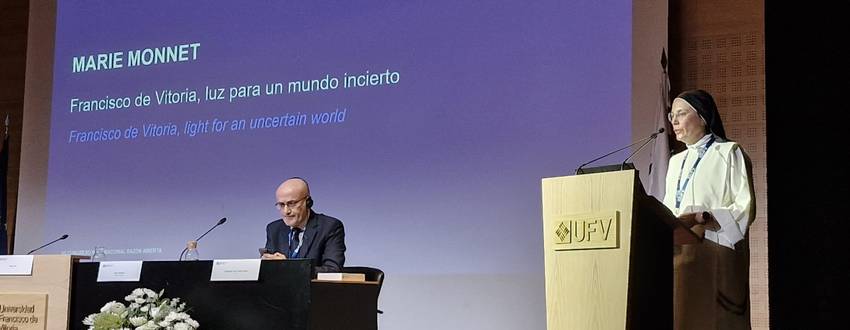
The inaugural lecture was delivered by Marie Monnet, Rector of Domuni Universitas. She addressed the audience in Madrid in her capacity as rector of an international university, within an institution that bears the name of Francisco de Vitoria. A Dominican sister, jurist, and specialist in international law, she has devoted her research to the School of Salamanca and to Vitoria, particularly through the study of freedom of movement, ius communicationis, and the emergence of a universal juridical vision.
Her lecture, entitled “Francisco de Vitoria: A Light for the University in Times of Uncertainty,” offered a reflection that was simultaneously academic, juridical, and spiritual. From the outset, Marie Monnet identified the central issue of her address: to speak of Vitoria in a university that bears his name is not merely to honour a memory. It is to embrace a vocation.
“A university that bears the name of Francisco de Vitoria does not merely carry the memory of a great theologian, jurist, Dominican, and master of Salamanca. It carries a question.” And that question remains alive: “What can reason accomplish when the world becomes uncertain? What can law achieve when power seeks to justify itself, when force becomes the only argument? What can the university do when societies begin to doubt truth, justice, peace, and sometimes even humanity itself?” With these words, the inaugural lecture established the tone of the congress. To reread Vitoria today is not to seek ready-made answers in the sixteenth century for the problems of the twenty-first. It is to recover a way of thinking. “A form of thought can still illuminate,” Marie Monnet affirmed. “A tradition can still open the future.”
Vitoria, Master of Courageous Thought
Marie Monnet recalled that Francisco de Vitoria did not think within a stable world. The sixteenth century was marked by the dramatic expansion of the known world, by conquest, violence, religious conflict, and political and imperial rivalries. Europe was encountering peoples, cultures, and forms of political organization previously unknown to it, yet this encounter unfolded within a context of domination and asymmetry.
It was precisely in this situation that Vitoria posed the decisive question: “By what right?” For Marie Monnet, this interrogation constitutes one of the greatest academic questions because it prevents the confusion of accomplished fact with justice, victory with law, and power with truth. As she emphasized in her lecture, Vitoria thought “in an age when power seeks its justification,” when “conquest would like to become law simply because it has taken place.”
Against this temptation, Vitoria asserted the demands of reason and law. He rejected the notion that force creates legitimacy. He maintained that the peoples encountered by the Spanish were not deprived of rights because of their religious, cultural, or political differences. “The Indigenous peoples possess dominium. They possess sovereignty. They possess rights. They are subjects of law,” Marie Monnet stressed.
This affirmation remains at the heart of Vitoria’s contemporary relevance. It reminds us that the university’s mission is to form minds capable of resisting the fascination of accomplished fact. As Marie Monnet stated, “A university exists so that thought may resist the fascination of accomplished fact.” It exists to remind us that “law is not the mask of force, but the limit of force.”
Ius Communicationis: A Theory of Just Relationship
One of the central themes of the inaugural lecture was ius communicationis, a key concept in Vitoria’s thought. Marie Monnet presented it as “the right of communication, the right of exchange, the right of relationship, the right to circulate and to enter into relationship with others.”
This intuition, born in the context of the first globalization, retains remarkable relevance. It affirms that human beings are not made to live in closed worlds, but to enter into relationships, encounter one another, travel, exchange, and learn from one another. Yet such openness is just only insofar as it respects the other. For Vitoria, communication can never become invasion, exploitation, or domination.
Marie Monnet emphasized this tension through a powerful formulation: “Openness without justice becomes domination. Justice without openness can become closure.” Vitoria’s genius lies precisely in holding together these two demands: openness and justice, mobility and law, relationship and reciprocity.
In a world characterized by the rapid circulation of people, capital, goods, images, data, and knowledge, this reflection appears particularly fruitful. Connectivity alone does not create community. Circulation alone does not produce justice. Globalization alone does not generate fraternity. Relationship must be ordered by the recognition of the other as a subject.
A Profound Resonance with Domuni Universitas
This reflection directly echoes the experience and mission of Domuni Universitas. As an international online university, Domuni welcomes students dispersed across numerous countries and makes access to knowledge, the circulation of learning, and intercultural dialogue constitutive elements of its academic project.
By speaking as Rector of Domuni Universitas, Marie Monnet grounded her intervention in a concrete academic experience: that of an institution striving to make demanding higher education possible beyond geographical, social, and cultural boundaries. In this respect, Vitoria’s ius communicationis illuminates the contemporary vocation of a university capable of connecting individuals, intellectual traditions, disciplines, and cultures.
Domuni Universitas thus embodies, in its own way, a contemporary realization of the Vitorian intuition: knowledge should neither be confined to a territory nor reserved for a restricted circle. It is called to circulate, but according to a logic of service, the formation of conscience, and the common good. As Marie Monnet stated in her lecture, “A university worthy of Vitoria does not merely seek to be open to the world. It seeks to understand what just openness to the world means.”
The University Confronting the Challenges of Artificial Intelligence
The Razón Abierta Congress has not confined itself to historical concerns. It has also situated Vitoria’s legacy within contemporary debates, particularly those generated by artificial intelligence. Marie Monnet demonstrated that the question posed by Vitoria in the sixteenth century reappears, in another form, in the twenty-first: What is the human person? What is a person? What cannot be reduced to calculation, data, performance, or algorithmic processing?
She recalled that every new form of power requires thought, law, and ethics. In Vitoria’s time, conquering power had to be subjected to the judgment of reason and law. Today, technological power requires the same discernment. “Not everything that is possible is just. Not everything that is efficient is human. Not everything that is fast is wise,” she affirmed.
Here the university has an essential mission: not merely to train users of technology, but to form consciences capable of discernment. It must learn to place the service of humanity, human dignity, and the common good at the heart of innovation itself.
Vitoria, A Teacher for Today
The first day of the congress was also devoted to Vitoria as a teacher and to the mission of the university professor today. Round-table discussions examined the professor as an educator of judgment and reflected on the unity of knowledge, from the sixteenth-century university to the contemporary university.
Marie Monnet particularly emphasized this pedagogical dimension of Vitoria’s legacy: “Vitoria was a professor. That is not a detail.” His influence derives not only from his written work, but from his teaching, his lectures delivered within a university, taken up by students, debated, and transmitted. “A lecture can traverse centuries. A question posed before students can alter the course of legal history,” she observed.
This conviction resonates with the deepest mission of every university: to form not only competencies but consciences. Teaching is not merely the transmission of knowledge; it is the formation of a way of seeking truth, exercising judgment, resisting slogans, and serving the world with justice.
A Humble and Demanding Light
The congress continues this reflection through discussions of the political, juridical, economic, and cultural debates associated with the Salamanca tradition. The programme includes presentations on international law, just war, civil authority, economics, evangelization within the university, and conscience in the age of artificial intelligence.
In celebrating the 500th anniversary of Francisco de Vitoria’s Chair of Prima, Francisco de Vitoria University does more than return to a great figure of the past. It invites participants to receive his legacy as a responsibility for the present.
Marie Monnet’s inaugural lecture expressed this conviction with particular force. Vitoria’s light, she recalled, is not a light that simplifies reality or removes complexity. It is “a more humble and more demanding light,” one that helps distinguish “the human person from what threatens him, law from force, mobility from invasion, openness from predation, and technique from wisdom.”
Perhaps this is the deepest significance of the congress: to remind us that the university is not merely a place of adaptation to the transformations of the world, but a place of discernment. It exists to seek truth, form consciences, serve human dignity, and build bridges of justice among peoples.
To reread Francisco de Vitoria today, in Madrid, five centuries after Salamanca, is therefore to recover a demanding imperative: to learn to look upon the human person in truth, so as never to despair of humanity. For, in Marie Monnet’s concluding words, “The human being is fragile, yet magnificent. And it is this magnificent humanity that the university is called to serve.”
You may read Dr. Marie Monnet, O.P.’s address in French here.
You may read Dr. Marie Monnet, O.P.’s address in English here.
You may read Dr. Marie Monnet, O.P.’s address in Spanish here.
The English and Spanish versions were generated with the assistance of artificial intelligence. The official version of the text is the French version.