




News
TELOS 14 - New Issue Published
2 june 2026
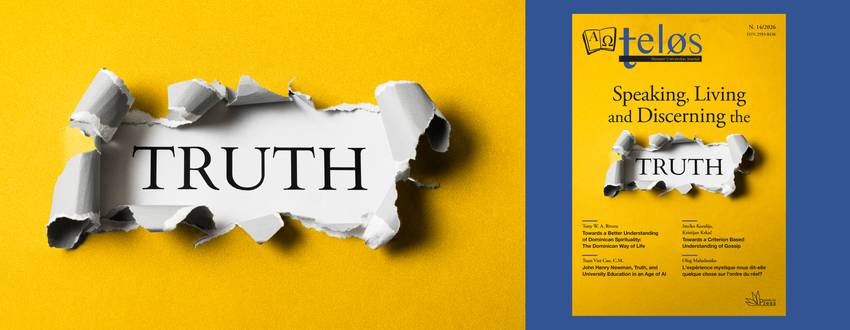
The latest issue of TELOS entitled “Speaking, Living and Discerning the Truth” is now available.
At a time marked by informational overload, technological acceleration, and deep cultural fragmentation, the question of truth acquires renewed urgency. Artificial intelligence can generate persuasive answers without understanding, public discourse is increasingly shaped by polarization and rumor, educational institutions face pressure to prioritize utility over wisdom, and religious communities are challenged to witness credibly to the truths they profess. In such a context, this new issue of TELOS offers a multidisciplinary reflection on how truth can be spoken, lived, and discerned in an increasingly complex world.
The theme of truth has always occupied a central place in human reflection. Philosophers, theologians, educators, and social thinkers have long wrestled with questions concerning how truth can be known, communicated, and embodied in everyday life. Yet in the contemporary world, these questions have gained a particular relevance. The unprecedented speed with which information circulates, the rise of digital technologies, and the increasing complexity of social and political life have transformed the conditions under which individuals seek meaning and understanding. In many respects, access to information has never been greater, yet confidence in truth itself often appears increasingly fragile.
The latest issue of TELOS responds to these challenges by bringing together a collection of scholarly contributions that examine truth from philosophical, theological, educational, and social perspectives. Rather than offering simplistic solutions, the volume encourages careful reflection on how truth is spoken, lived, and discerned in diverse contexts. Through its interdisciplinary approach, it invites readers to engage with some of the most pressing intellectual and spiritual questions of our time.
The opening article, “Towards a Better Understanding of Dominican Spirituality: The Dominican Way of Life,” by Tony W. A. Rivera, explores the rich spiritual heritage of the Dominican tradition. Rivera presents Dominican spirituality not merely as a set of doctrines or devotional practices, but as a coherent way of life grounded in the pursuit of truth. Drawing inspiration from the life and example of Saint Dominic, the article examines how communal life, prayer, study, and preaching form an integrated path toward spiritual maturity. Particular attention is given to what the author calls the “Grace of the Word,” a dynamic understanding of truth that unites contemplation with action. In an age often characterized by fragmentation and uncertainty, the Dominican tradition offers a model of intellectual rigor, spiritual depth, and meaningful engagement with the world.
The second contribution, “John Henry Newman, Truth, and University Education in an Age of AI,” by Tuan Viet Cao, C.M., addresses one of the most urgent debates facing higher education today. Revisiting the thought of John Henry Newman, one of the most influential figures in the philosophy of education, the article argues that the primary purpose of the university is not simply the transmission of information but the formation of judgment. Newman’s understanding of truth as the guiding norm of inquiry is placed in dialogue with contemporary challenges such as artificial intelligence, the marketization of education, and the growing emphasis on vocational outcomes. At a moment when machines can produce sophisticated texts without genuine understanding, the article offers a powerful reminder that education is fundamentally concerned with forming persons capable of critical thinking, responsible judgment, and meaningful engagement with reality.
The third article, “Towards a Criterion-Based Understanding of Gossip,” by Dr. Srećko Koralija O.P. and Kristijan Krkač, examines a subject that is often overlooked in academic discourse despite its significance in everyday life. Gossip is a common feature of human interaction, yet its moral and social implications are rarely analyzed in depth. Through a systematic and criterion-based approach, the authors investigate the nature of gossip and the conditions under which it can be considered morally acceptable or harmful. Their analysis reveals the complexity of human communication and demonstrates that speech is never entirely neutral. Depending on its context, intention, and consequences, gossip may contribute either to social cohesion or to the erosion of trust and reputation. The article therefore raises important questions about ethical responsibility in communication and the role of truthfulness in social relationships.
The volume’s final research article, “L’expérience mystique nous dit-elle quelque chose sur l’ordre du réel ? L’exemple de Thérèse d’Avila,” by Oleg Malashenko, turns to the relationship between mystical experience and knowledge of reality. Focusing on the spiritual experiences of Saint Teresa of Ávila, the author explores whether encounters described as mystical can provide genuine insight into the nature of existence. The article examines the communicability, credibility, and epistemological significance of such experiences, arguing that they deserve serious consideration within philosophical and theological inquiry. While mystical experiences do not conform to the standards of empirical verification commonly associated with modern science, they nevertheless constitute important dimensions of human experience that may illuminate questions concerning transcendence, meaning, and the ultimate structure of reality.
The issue also includes a thoughtful book review by Michael Humpherys of David Hunt’s Something for Nothing? An Explanation and Defence of the Scholastic Position on Usury. The review revisits a longstanding debate within moral theology and economic thought concerning the legitimacy of interest and lending practices. By examining the scholastic tradition’s understanding of usury, the review highlights the enduring relevance of historical theological perspectives for contemporary ethical discussions about finance, justice, and economic responsibility.
Taken together, the contributions gathered in this issue demonstrate the richness and diversity of contemporary scholarship on truth. Although the articles approach the subject from different disciplines and methodologies, they share a common concern: understanding how truth can guide human thought, action, and community life. Whether through spiritual practice, educational formation, ethical communication, mystical experience, or social reflection, each contribution offers valuable insights into the enduring human search for meaning and understanding.
TELOS is an international, open-access journal published by Domuni Press, dedicated to fostering scholarly dialogue in philosophy, theology, social sciences, and religious studies. By providing a platform for researchers from diverse cultural and intellectual backgrounds, the journal encourages rigorous academic exchange and constructive engagement across disciplines. In a world increasingly marked by division and uncertainty, such dialogue is more important than ever.
This latest issue continues that mission by inviting readers to reflect on one of the most fundamental questions of human existence: the question of truth. Far from being an abstract or purely theoretical concern, truth remains at the heart of personal identity, social life, education, and faith. The essays collected in Speaking, Living and Discerning the Truth remind us that truth must not only be sought intellectually but also embodied in practice and discerned with wisdom. In doing so, they offer a timely and meaningful contribution to contemporary academic and spiritual reflection.
Find all the previous issues here.