



News
Looking Back at the 2026 International Summer School in Tours, France
20 july 2026
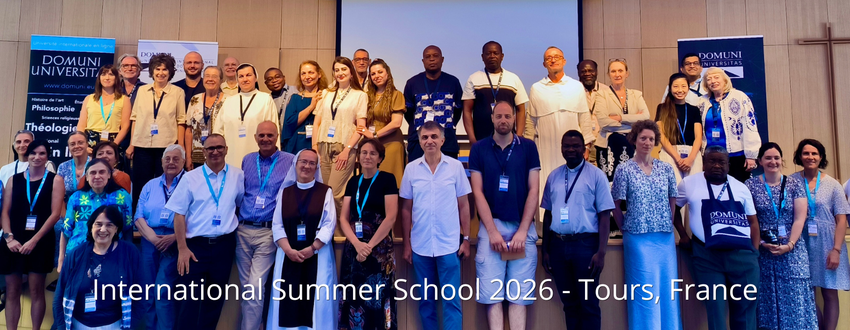
From 6 to 10 July 2026, Domuni Universitas held its International Summer School in Tours, France. For one week, professors, students, and international speakers gathered around a central theme: “Transmitting and Creating within the Christian Tradition.” The event provided a significant opportunity for academic reflection, intercultural encounters, and the discovery of the Christian heritage.
A Week Dedicated to Reflecting on the Future of Transmission
How can an inheritance be transmitted without becoming fixed? How can a tradition remain alive in a rapidly changing world? How can new generations of students be supported in a context shaped by technological developments, particularly those related to artificial intelligence?
These fundamental questions formed the foundation of Domuni’s 2026 International Summer School. Bringing together an international community from more than fourteen countries, the event offered a unique space for dialogue between theology, philosophy, art, pedagogy, culture, and innovation.
The week opened with the inaugural lecture by Dr. Marie Monnet, O.P., Rector of Domuni Universitas, entitled “A Faith That Generates: Heritage, Interpretation, and Creation.” Her lecture established the guiding theme of the Summer School: the Christian tradition is not a static inheritance but a living reality that is continually transmitted, interpreted, and renewed.
In a world undergoing profound transformation, particularly through the rapid development of artificial intelligence, the lecture emphasized the need for academic discernment: preserving what lies at the heart of transmission while developing new ways of teaching, learning, and creating.
Faculty Members Addressing the New Challenges of Distance Higher Education
This edition brought together 24 faculty members from around the world, who devoted their mornings to collective reflection on the future of online higher education.
At the heart of their discussions was student support and the essential role of mentoring in online education. How can meaningful pedagogical relationships be fostered at a distance? How can an academic community be animated across geographical boundaries?
Participants also examined the impact of artificial intelligence on teaching practices. Rather than being approached merely as a technical tool, AI was considered an issue requiring critical reflection and responsibility: how can it be integrated while preserving the human, relational, and formative dimensions of education?
These working sessions enabled faculty members to share their experiences, compare their practices, and imagine together new ways of accompanying students throughout their academic journey.
Major Lectures Exploring the Paths of the Christian Tradition
Alongside the programme designed for faculty members, sixteen international students attended the Major Lectures offered throughout the week. Widely accessible to online audiences, these lectures enabled more than 500 participants worldwide to follow the presentations live on YouTube.
Through several complementary perspectives, the lectures explored different dimensions of Christian transmission.
Dr. Olivier-Thomas Venard, O.P., Director of the research programme The Bible in Its Traditions at the École Biblique et Archéologique Française de Jérusalem, devoted his lecture to Scripture and Its Reception in the Contemporary World. He emphasized that the Bible cannot be understood independently of its history of reception: it is a living tradition, continually reread and interpreted by successive generations.
His presentation also highlighted the new opportunities offered by digital tools for biblical studies, making it possible to establish dialogue between biblical texts, their interpretative traditions, and artistic heritage, particularly through the Bible Art application.
Professor Frédéric Curnier-Laroche then invited participants to explore the relationship between Art, Theology, and Creation. Through works by Leonardo da Vinci, Rembrandt, Caravaggio, and contemporary artists, he demonstrated how art can become a pathway toward mystery. Artistic creation is not merely an aesthetic production; it can open a space where the visible leads toward the invisible and where human creativity enters into dialogue with divine creation.
Finally, Sr. Agnès Bruyère offered a reflection on The Jewish Sources of the Christian Faith, retracing the major stages of dialogue between the Catholic Church and Judaism. Her lecture deepened participants’ understanding of the historical and theological roots of Christianity while examining the contemporary challenges of Jewish-Christian dialogue.
The week concluded with the lecture delivered by Dr. Ameer Jaje, O.P., dedicated to Interculturality and Interreligious Dialogue in International Distance Learning Environments.
Drawing upon his experience of welcoming students and faculty members from diverse cultural and religious backgrounds, he showed how digital learning environments can become genuine places of encounter. Distance education is not merely a technological challenge; it also creates opportunities for dialogue in which cultural and religious diversity becomes a source of enrichment for education. His reflection highlighted the importance of a pedagogy grounded in listening, mutual understanding, and respect for differences.
Tours and the Loire Valley: Discovering a Living Heritage
The Summer School extended beyond its academic programme. Conceived as a natural continuation of the morning lectures, visits to the Christian and cultural heritage of the Loire Valley enabled participants to anchor their reflections in living places where history, art, and spirituality themselves become sources of transmission.
In Tours, students and faculty members discovered the city’s principal spiritual landmarks: Saint-Gatien Cathedral, the Basilica of Saint Martin, and the tomb of Saint Martin. The visit offered an opportunity to revisit the Christian history of the city through its architecture, its spiritual figures, and the traces left by centuries of transmission.
The following day, participants continued their exploration with a visit to the Château d’Amboise, an emblematic site of French history and a witness to the dialogue between artistic creation, political power, and culture.
In Blois, the visit to the Basilica of the Holy Trinity offered a fresh perspective on the religious heritage of the 1930s and devotion to Our Lady of the Three Hail Marys, before concluding this cultural immersion with the sound-and-light show at the Château de Blois. Through its staging of history and monuments, the evening beautifully illustrated the central theme of the week: to transmit also means to tell stories, reinterpret, and keep heritage alive.
An International Community Called to Meet Again
Beyond the lectures and cultural visits, the 2026 International Summer School was above all a deeply human experience. Informal exchanges, conversations among participants, and moments of fellowship created lasting bonds between people from diverse backgrounds.
The week demonstrated that the transmission of knowledge depends as much on the quality of academic content as on the richness of human encounters. By bringing together faculty members, students, and researchers around a shared desire to learn and exchange ideas, Domuni Universitas continues to fulfil its mission: making higher education a place of dialogue, reflection, and creativity.
The 2026 International Summer School will remain a defining moment in the life of Domuni Universitas: a week in which the Christian tradition, far from being confined to the past, revealed itself as a source of inspiration for thinking about the future.