



News
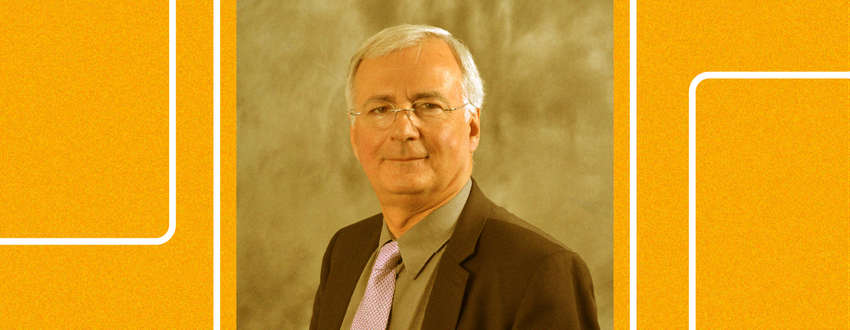
Michel Garnier — The Quest For Living Knowledge
15 november 2025
Returning to Studies to Open a New Horizon
When Michel Garnier retired, he had long nurtured the wish to reconnect with the university. After a career within the La Poste group — banking operations director, president of a subsidiary, deputy general director of the network — he felt the need to return to his roots: to “turn the page to another chapter of his life, more intimate and more spiritual.” The intellectual and the believer wished to engage in dialogue; professional experience gave way to a desire for contemplation and depth.
At first, he tried history at the Sorbonne, then philosophy via CNED, but those institutions, he says, did not meet his expectations: education felt “rigid, impersonal and constraining.” The urge to study theology became increasingly insistent — no doubt because theology unites knowledge, spiritual quest, and personal rooting.
It was then that he discovered Domuni Universitas: a structured teaching program, written courses, a living pedagogy, and a community present even across a screen. The welcome from Michel Van Aerde, then rector of Domuni, completed his conviction.
“I came away enthusiastic and wholly convinced.”
His learning unfolded over several years, with a thoughtful organization: two sliding years equaled one academic year — a pace allowing the precious balance between family life, travel, availability for his grandchildren, and academic demand.
“For the retiree that I am, it was ideal.”
For him, the strengths of Domuni were numerous: the quality of the courses, the richness of the feedback, the forum for exchanges with teachers, and above all the thematic seminars — “two-month sprints” that left him “exhausted but delighted,” so intense and fruitful were the academic exchanges.
The subjects studied nourished his mind as much as his faith: Christology, the Holy Spirit, theodicy, the Pauline epistles, religious semiology, as well as the history of Judeo-Christian relations. This diversity grounded him in a broader vision of the world and of theology.
He sums up his experience thus: studying at Domuni is experiencing “an opening onto the immensity of knowledge and transcendence from the small window of one’s computer screen.”
An Intimate Research Subject: Corsican Popular Religiosity
The choice of his dissertation topic — later his book — imposed itself almost naturally: the Corsican popular religiosity. A theme deeply rooted in his family memory and in the Corsica of his childhood. Michel Garnier speaks with emotion about the processions of August 15 at Pietralba: statues carried through the village, chants, confraternities, salvos of rifles that gave the celebration a mixture of “reverence and exultation.”
In 2023, attending the Assumption Mass at Allauch with his grandchildren, memories surged: “I felt that my place was over there and that I had never left it.”
This theme — first proposed in a practical theology assignment — became a vast field of exploration for his master’s dissertation under the supervision of Dr. Evelyne Maurice: a study of Corsican popular religiosity in its depth, its history, and its remarkable contemporary vitality.
Corsican Faith: A Living Heritage, Unique within the French Landscape
Michel Garnier insists: Corsican popular religiosity is not folklore. It is a “sincere piety” and the “keen awareness of a heritage to transmit,” in the face of the risk of cultural or spiritual de-vitalization.
Since the 1990s, the movement of reappropriation — Riacquistu — born in the 1970s under the banner of nationalism, has transformed and given new breath to the island’s faith and heritage. The confraternities play an essential role in this revival: over 3,500 members, 130 confraternities, a daily presence in the villages, communal celebrations, solidarity, heritage maintenance, sacred polyphonic chants.
This contemporary religiosity goes beyond the liturgical frame: it embraces the integral vision of Laudato Si’ by associating environmental preservation, restoration of villages, agricultural renewal, and cultural revitalization. A faith incarnate, communal, and rooted.
What makes Corsica different also lies in its ecclesiastical history: long under direct influence of the Vatican, little affected by gallicanism, shaped by Italian Enlightenment rather than French. Laïcité there is “healthy,” “serene,” a respectful balance between civil and religious institutions.
Thus, prefects, elected officials, and clergy participate together in processions without surprise; this is the case for all major religious festivals, such as December 8 — celebrating the Immaculate Conception, and also the feast of the Corsican Nation.
A Research Enlightened by Providence
One of the most striking aspects of Michel Garnier’s testimony is his sense of being accompanied by something beyond him. When he chose his dissertation topic in 2023, he had no idea that Corsican popular religiosity would become central to the visit of Pope Francis a year later — the first papal visit to Corsica since Christianity began there.
“Providence does things very well and smiled on me,” he writes with gratitude.
His participation in the seminar on Corsican popular religiosity, his meeting with Cardinal Bustillo, and the significant interventions of Mgr Bouwer and Jean-Charles Adami — these are all powerful moments that nourish his reflection and his work.
His Book is an Act of Transmission
Michel Garnier’s book is not merely the outcome of academic work: it is the expression of a return to origins, of fidelity to family memory, of a loving gaze cast upon Corsica, and of deep gratitude toward those who transmitted to him faith, culture, and belonging.
It is also a testimony: that of a life showing that it is never too late to learn, to understand, and to transmit.
If you wish to order the book, you can do so here.