




News
INTEGRAL Journal: A New Forum for Reflection on Human Development
30 march 2026
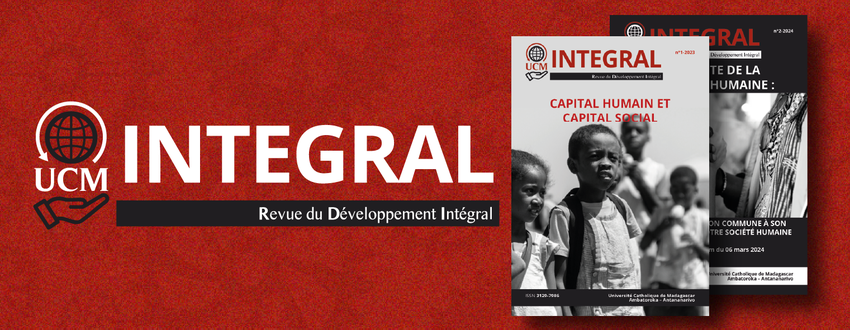
The launch of the Jounal INTEGRAL – Journal of Integral Development marks an important milestone in the deployment of the scientific partnership between Domuni Universitas and the Catholic University of Madagascar (UCM).
More than a simple editorial launch, this event is part of a broader dynamic: that of an international academic dialogue, rooted in local contexts and oriented toward a global reflection on the challenges of human development.
A Journal Serving an Integral Vision of the Human Person
The INTEGRAL Journal is part of a precise intellectual tradition, notably inspired by the encyclical Populorum Progressio of Saint Paul VI, which called for the promotion of “integral development, the development of every person and of the whole person.” This reference is not merely theoretical; it deeply shapes the identity of the journal.
In a world marked by rapid transformations, persistent inequalities, and cultural and social tensions, the question of development can no longer be approached in a fragmented way. On the contrary, INTEGRAL proposes a comprehensive approach, attentive to the economic, social, political, cultural, and spiritual dimensions of the human person.
An annual multidisciplinary scientific journal, it welcomes contributions from the humanities and social sciences and aims to serve as a space for dialogue between disciplines, cultures, and continents. It thus offers an academic platform open to researchers, teachers, and practitioners engaged in analyzing contemporary dynamics of development.
The Fruit of a Structuring Partnership
The creation of the INTEGRAL Journal originated in the partnership concluded on December 6, 2021, between Domuni Universitas and the Catholic University of Madagascar. This agreement aimed to establish lasting collaboration in the cultural, scientific, and technological fields, promoting the exchange of knowledge and the implementation of joint projects.
UCM, a dynamic university institution structured around three faculties—social sciences, ecclesiastical sciences, and humanities—constitutes a privileged partner for Domuni Universitas, whose vocation is precisely to connect minds around the world through distance learning.
This partnership was not limited to a declaration of intent. It quickly gave rise to concrete initiatives, including the holding of a Study Day in Tananarivo in February 2025, devoted to corruption, as well as a widely attended Conference by Dr. Amir Jajé, Vice-Rector of Domuni Universitas, on interreligious dialogue and the path toward mutual understanding.
The scientific quality of the journal is ensured by an editorial board and an international scientific committee bringing together teacher-researchers from various disciplines and institutions. Under the direction of Dr. Lambert Rakotoarisoa, the journal relies on the expertise of this review board to guarantee the academic rigor of published contributions and to foster demanding, open, and interdisciplinary scientific dialogue.
The Online Publication of the 2024 Colloquium: A First Academic Outcome
The first issue of the INTEGRAL Journal, devoted to the theme of “human capital and social capital,” lays the foundations for the reflection promoted by the journal. It highlights the importance of knowledge, skills, health, and social conditions in the development of individuals and societies. Through a multidisciplinary approach, this issue underscores the decisive role of education, training, mobility, and social policies in combating poverty and promoting more inclusive development.
The second issue of the INTEGRAL Journal, published in March 2026, presents the proceedings of the symposium entitled: “The dignity of the human person: from a shared understanding to its application in our society.” Organized at the Catholic University of Madagascar, this event brought together researchers from various disciplines around a central and universal question.
This colloquium was a founding moment. It enabled theologians, philosophers, jurists, sociologists, and specialists in the humanities to engage in dialogue around a concept that is both fundamental and often debated: human dignity.
The contributions gathered in these two issues testify to the richness of these exchanges. They address the themes from various perspectives: theological, biblical, metaphysical, moral, legal, sociological, and political. Some examine the foundations of dignity, while others explore its concrete implications, particularly in specific contexts such as prison conditions in Madagascar or the world of work.
These first online publications constitute the first tangible fruit of the editorial partnership between Domuni and UCM. They demonstrate the fruitfulness of a collaboration that is not limited to institutional exchanges but produces a living, rooted, and engaged body of thought.
This dynamic continues with the preparation of a third issue, currently ready to be published online, devoted to the question of corruption, a major challenge for the development of contemporary societies and for the promotion of ethical and responsible governance.
An Embodied Presence: The Journey to Madagascar
Beyond academic production, this partnership has also been nourished by human encounters. In 2025, the meeting of the Rectors—Dr. Lambert for the Catholic University of Madagascar and Dr. Marie Monnet for Domuni Universitas—accompanied by their respective teams, further deepened and structured this collaboration.
Organized in Tananarivo, this institutional meeting marked a decisive step in consolidating the relationship, making it possible to gauge the intellectual vitality generated by this cooperation and to bring new projects to light.
This visit made it possible to encounter a youth animated by a deep desire to learn and to commit themselves. In lecture halls as in informal exchanges, the same energy was evident: that of an intelligence in motion—open, curious, and ready to engage in dialogue with the world.
This experience confirmed a founding intuition of Domuni Universitas: knowledge has no single center. It circulates, transforms itself, and is nourished as much by the peripheries as by established institutions. In Madagascar, this conviction took concrete form. The students met, the committed teachers, and the shared discussions revealed a vibrant intellectual space, fully capable of contributing to global reflection.
The INTEGRAL Journal thus appears as the natural extension of these encounters. It offers a place where these voices can be heard and where these reflections can be shared on an international scale. Special mention should be made of Dr. Sohary Manambahy Razanaparany, Director of the Research Center, whose constant commitment has been decisive in implementing and developing the partnership.
Institutional Recognition and a Reach to Be Built
The official registration of the journal, with the assignment of ISSN 3129-7986, marks an important step in its institutionalization. It enables its identification within international academic networks and opens the way to its indexing in major scientific databases.
Published under the direction of Father Rector Lambert Rakotoarisoa, this editorial project is carried by DOMUNI-Press, the academic publishing house linked to Domuni Universitas, committed to disseminating works in philosophy, theology, and the humanities and social sciences.
The prospects for development are numerous: improving online accessibility, optimizing the display of articles, translation and international dissemination, and the availability of a print-on-demand version. The latter will allow for wider circulation of the content while leaving UCM in control of printing and distribution in Madagascar.
A Dynamic Called to Unfold
The INTEGRAL Journal does not constitute an endpoint but a starting point. It inaugurates a dynamic destined to unfold in the years to come through new thematic issues, new research projects, and new scientific collaborations.
It is part of a broader vision: that of universities open in the deepest sense of the term “catholic,” that is to say universal—capable of connecting minds, crossing perspectives, and producing thought that is both rigorous and engaged.